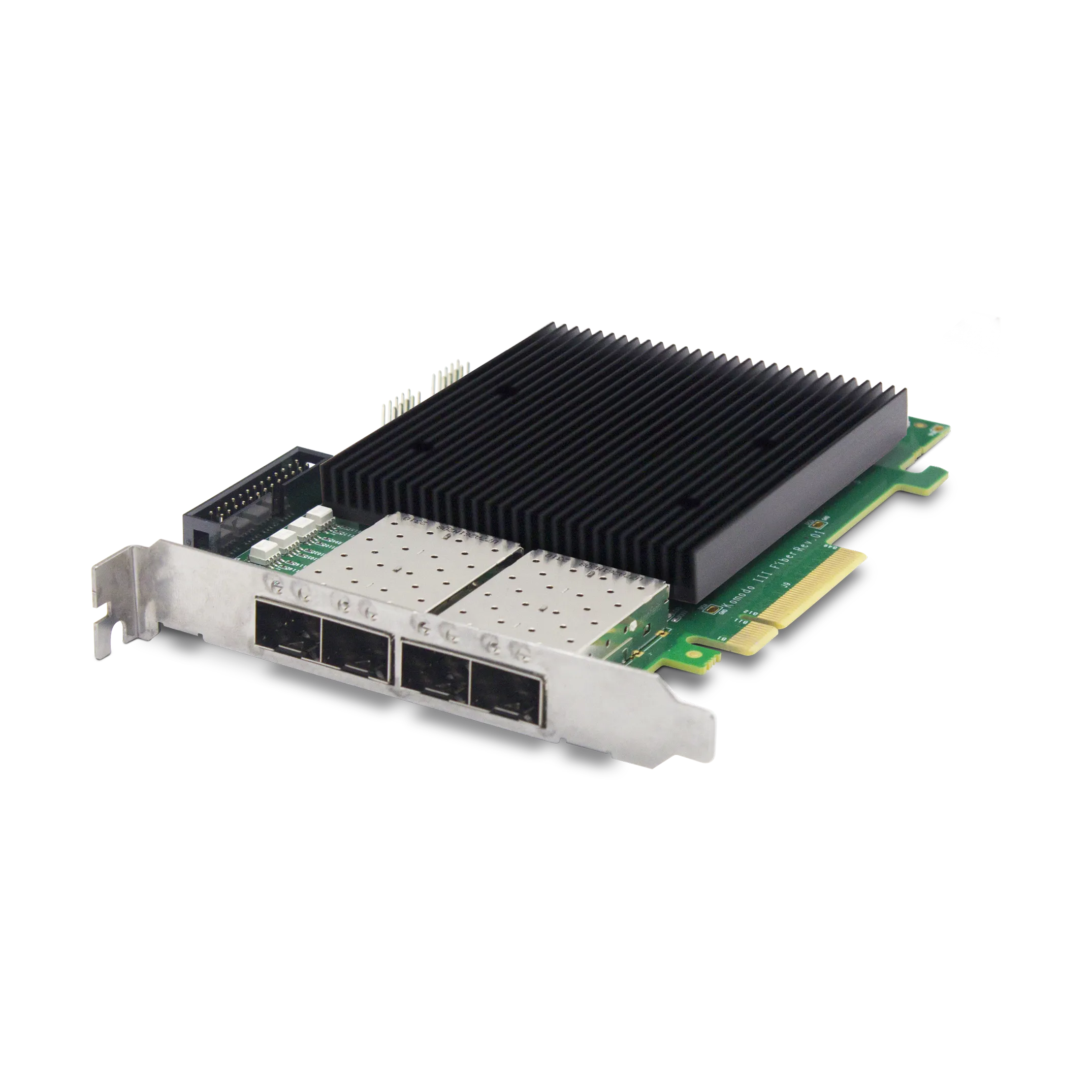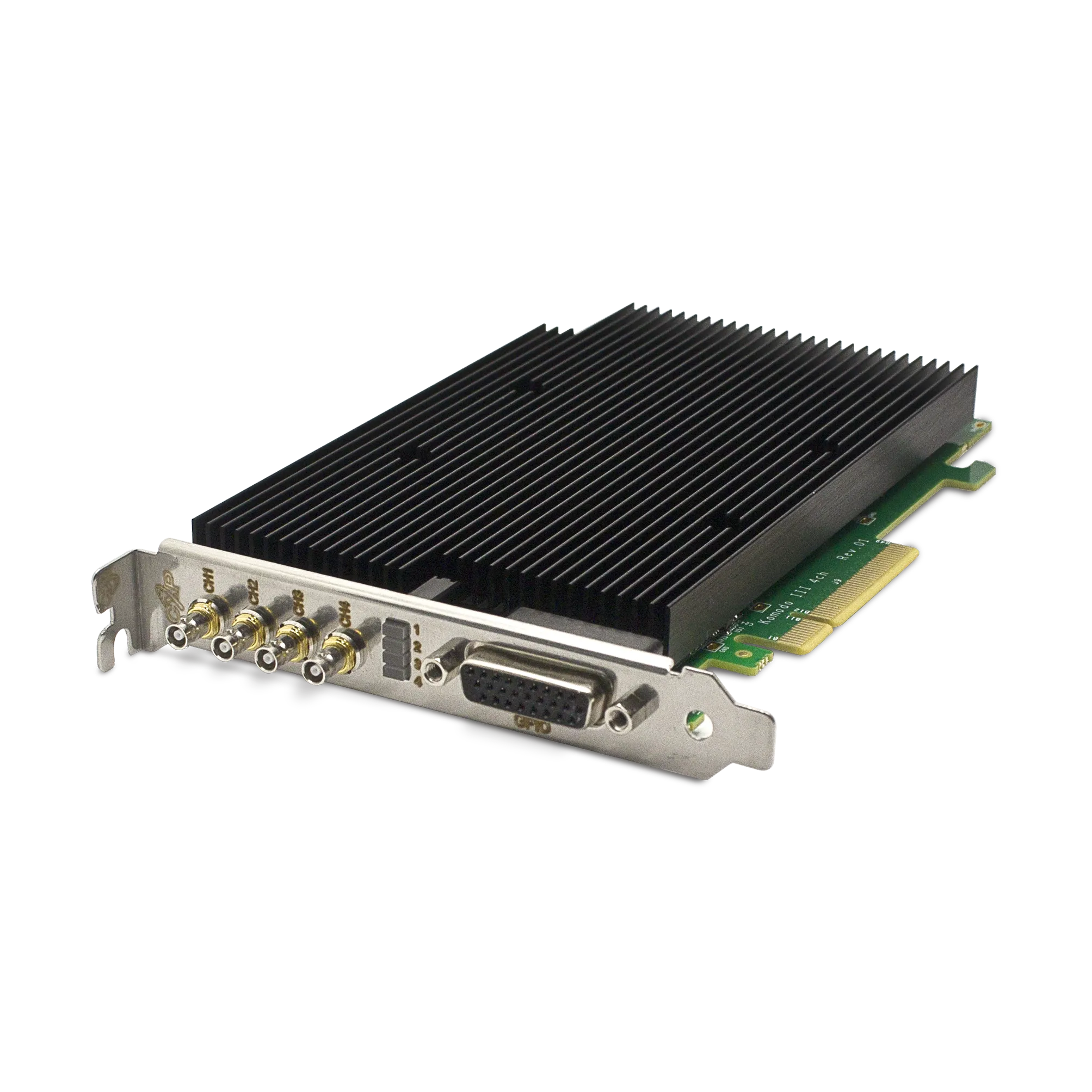
PCIe frame grabber bandwidth must cover the bytes delivered to host memory at the required acquisition rate. Camera link speed alone does not answer that question: pixel packing, simultaneous streams, negotiated PCIe lanes and application copies all affect the result. Build separate budgets for the incoming link, the DMA transfer and the processing pipeline before selecting hardware.

Calculate the image payload first
For an uncompressed area-scan stream, the average image payload is width × height × frames per second × bytes per pixel. Use the actual transport format for the link calculation and the delivered buffer format for the host calculation. A 12-bit sample can occupy 1.5 bytes when tightly packed or 2 bytes when unpacked into a 16-bit container. Padding, chunk data and protocol overhead require additional allowance.
| Illustrative workload | Calculation | Image data rate |
|---|---|---|
| One 4096 × 2160 stream, 100 fps, packed 12-bit | 4096 × 2160 × 100 × 1.5 | 1,327.1 MB/s |
| Same stream, 16-bit host buffers | 4096 × 2160 × 100 × 2 | 1,769.5 MB/s |
| Four streams, packed 12-bit | 4 × 1,327.104 | 5,308.4 MB/s |
| Four streams, 16-bit host buffers | 4 × 1,769.472 | 7,077.9 MB/s |
These are calculated decimal MB/s values, not measured performance. Where unpacking occurs determines which rate crosses PCIe. If the grabber delivers 16-bit pixels, use the larger figure for DMA. If software unpacks after acquisition, budget the packed DMA rate and the additional memory reads and writes separately. KAYA’s bandwidth guidance explains the effects of pixel format, link configuration and host connection.
Compare sustained delivery with the real slot
The Komodo III Quad CoaXPress 12G lists PCIe 3.0 ×8 and 6,695 MB/s sustained delivery, dependent on the host PC. The four-stream 16-bit example exceeds that published sustained figure before adding overhead. The packed example is below it, but still needs a complete link and host test; it is not a compatibility guarantee.
A mechanically long slot may have fewer electrical lanes or share resources with another device. Record the negotiated generation and lane width after installing the card, then repeat the check with the GPU, storage and other peripherals installed. Basler’s frame-grabber host requirements describe the same physical-slot versus electrical-link distinction.
Maintain three separate budgets
- Input: sum every active stream, including packing and transport overhead. Check peak bursts as well as the average rate.
- DMA: use the host buffer layout, stride and negotiated PCIe connection. Onboard buffering can absorb a short interruption but cannot correct a sustained deficit.
- Processing: account for CPU copies, unpacking, GPU transfers, display and recording. Each extra full-frame copy consumes memory bandwidth even when the camera rate is unchanged.
Validate the complete acquisition workload
Start with acquisition into queued buffers and minimal processing. Add image conversion, inference and recording one stage at a time. Track delivered frames, incomplete buffers, queue occupancy and latency over the intended operating duration. Test warm hardware and simultaneous streams, not just a short single-stream run. Choose your reserve from measured burst and processing behavior rather than treating an arbitrary percentage as a universal rule.
Does a faster PCIe slot always solve dropped frames?
No. It helps only when the host connection is the limiting stage. Cable errors, a slow consumer, unavailable buffers and trigger configuration can produce similar symptoms. Use the dropped-frame troubleshooting sequence to isolate the constraint before changing hardware.
For a selection review, send KAYA the resolution, pixel format on the wire and in memory, stream count, frame rate, motherboard and processing destination. Contact KAYA Instruments with that worksheet to discuss an appropriate acquisition configuration.