A missing image does not always mean the CoaXPress link dropped a frame. The camera may not have received a trigger, the receiver may have reported a transport error, or the application may have failed to return an available buffer. Diagnose the stage that loses data before replacing the frame grabber or increasing memory.

Establish a reproducible baseline
Save the camera configuration, frame-grabber model, firmware, SDK version, link rate, cable arrangement and host slot. Run one stream with minimal processing at a conservative rate. Record the expected and delivered frame counts over a fixed interval. Increase one variable at a time so that a change in behavior has an identifiable cause.
KAYA documents CRC, dropped-packet and dropped-frame counters in Vision Point’s Extended Stream Features statistics. Its CRC and stream-statistics procedure also covers per-link information for fiber acquisition. Capture the counters before and after the same test interval; a cumulative total without a baseline is difficult to interpret.
Use the symptom to choose the next test
| Observation | Next evidence to collect |
|---|---|
| CRC or packet-error counters increase | Link rate, cable and connector condition, optical diagnostics where available; repeat with a known-good compatible path. |
| Expected triggers exceed acquired frames, with clean link counters | Trigger source, polarity, pulse timing and whether the camera can accept the requested trigger rate. |
| Acquisition works until processing or recording starts | Available buffer count, callback duration, disk stalls and processor or GPU load. |
| Failure appears only with several streams | Aggregate host data rate, negotiated PCIe width and shared-system contention. |
These observations narrow the investigation; none proves a cause alone. For example, a camera reset caused by unstable power can interrupt acquisition even when the original problem is upstream of the data receiver.
Calculate the time represented by a buffer queue
Suppose an application has 16 available frame buffers and acquisition runs at 200 frames per second. Those buffers represent at most 16 ÷ 200 = 80 ms of arrivals if the consumer stops entirely. If four buffers are already occupied, the remaining 12 represent only 60 ms. This simplified calculation excludes pipeline details but exposes why a brief storage stall can exhaust a seemingly generous queue.
Adding buffers can cover bounded stalls. It cannot sustain a consumer that processes 150 frames per second while acquisition continuously supplies 200. The backlog grows by 50 frames each second. Reduce the input rate, increase processing throughput or adopt an explicitly documented frame-selection policy appropriate to the application.
Separate acquisition from application processing
- Run the vendor acquisition example with the intended pixel format and stream count.
- Keep buffer-completion callbacks short; hand work to a processing stage and return buffers only when all users have finished.
- Measure sustained acquisition with display and recording disabled, then enable them independently.
- Check frame identifiers and timestamps where supported. Document any deliberate frame skipping so it is not mistaken for transport loss.
- Repeat at the intended cable length and warmed-up operating conditions before accepting the fix.
Use the PCIe bandwidth worksheet when failures track aggregate data rate. For hardware-triggered systems, the synchronization checklist separates exposure timing from host arrival timing.
What should a support report include?
Provide a short reproduction procedure, complete software and hardware versions, expected versus received counts, counter deltas, trigger settings and the smallest configuration that fails. Include whether the same setup succeeds at a lower rate. This evidence is more useful than a screenshot of a frozen display alone.
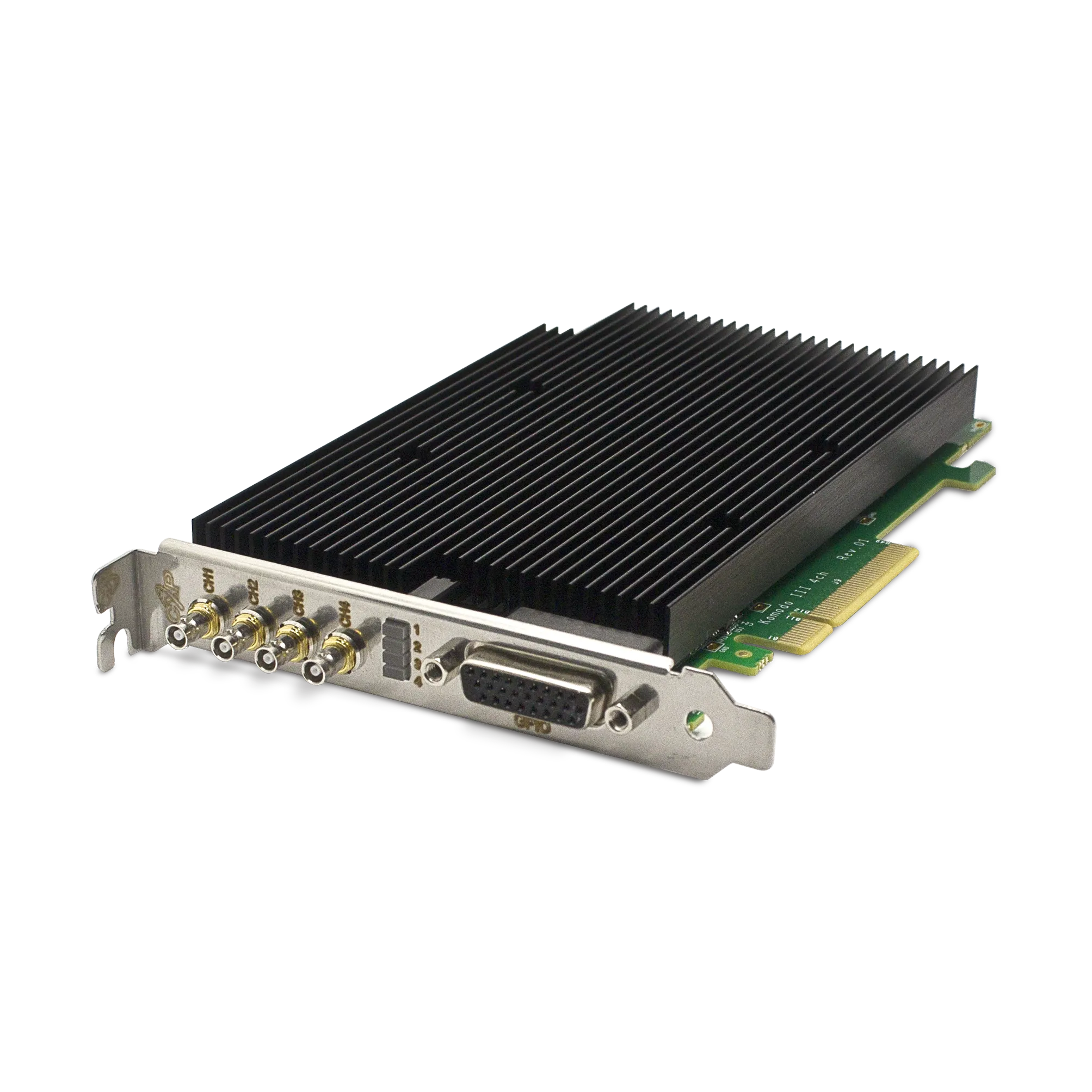
The Komodo III Quad CoaXPress 12G is one acquisition option for multi-link CoaXPress systems. Ask KAYA Instruments to review the measured fault evidence and host configuration before selecting a replacement or expanding the system.